

It’s been several thousand years since Nimrod built the Tower of Babel, but now, we are perhaps one or two decades away from living on Mars, per Elon Musk’s determination.
Yet some problems, even for high-achieving innovators, remain beyond the reach of artificial intelligence, revolutionary scientific discoveries, and mind-bending psychological models.
In a rare setting for an evangelical preacher, Billy Graham’s 1998 TED Talk is one of the most biblically grounded presentations in TED's archives.
Since then, technology continues to advance in ways his audience could scarcely have imagined, but the three fundamental problems Graham identified may remain existential even in the distant future:
Human evil
Human death
Human suffering
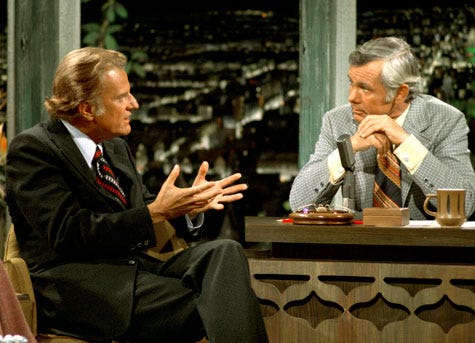
“Have you ever thought about what a contradiction we are?” Graham asked. “On one hand, we can probe the deepest secrets of the universe and dramatically push back the frontiers of technology. We've seen under the sea, three miles down, or galaxies hundreds of billions of years out in the future.”
But on the other hand, you’d find many things awry. Christians are being persecuted in Nigeria. Violence and famine rage on in the Horn of Africa, and Israel is locked in a protracted conflict with various forces in Palestine.
Human evil
Every year, the world loses over $3.6 trillion to corruption, even in the fun and ‘benign’ things that should unite humanity, such as music and sports, but neither is exempt from the dubious and vile.
Since 1844, when horse racing captivated the world, sports corruption has been a concern and has grown in various ways, culminating, we may say, in such high-profile cases as the arrest of former FIFA President Sepp Blatter in 2015.
Music concerts have experienced tragedy of diverse proportions too, ranging from the stabbing of three children at a dance class to death, to the October 7 attack when Hamas killed about 1,200 people and took more than 250 hostage.
We assume that the stronger our technology systems, the more secure we will be. Yet advances in security technology, such as data-informed occupancy management, cannot eliminate the perpetual manifestations of evil, which stem from moral and spiritual failures.
Jesus said, “For out of the heart come evil thoughts, murders, acts of adultery, other immoral sexual acts, thefts, false testimonies, and slanderous statements.“
Emmanuel Kant suggested that evil stems from:
a weakness in doing what is right (frailty),
a desire for gain (impurity),
or an actualization of selfish interest (perversity).
This tendency for evil is the reason “we can’t get along with other people, even in our own families. We find ourselves in the paralyzing grip of self-destructive habits we can’t break. Racism and injustice and violence sweep our world, bringing a tragic harvest of heartache and death,” Graham said.
He then issued a provocative challenge: “I would like to see Oracle take up that, or some other technological geniuses work on this.”
Granted, there are scientific and systemic innovations aimed at combating corruption even at its root, but they do not scratch the surface, as the problem isn’t merely social or systemic but intrinsic.
That’s why Graham also asked, “How do we change man, so that he doesn’t lie and cheat?”
But even if a person, system, or company launched a solution to steer humanity away from our evil desires, that entity could itself be laden with the same bias for some form of evil, just as we are.
The ultimate, all-benevolent innovation to human evil, therefore, would need to be invented by a completely neutral force, the only one of which in human and extra-terrestrial history is none other than God.
Human suffering
The second dilemma Graham addressed was suffering, the universal human experience that transcends socioeconomic status and technological advancements.
“I have never met a person in the world who didn’t have a problem,” said Graham.
At nearly 80 years old when delivering the talk, Graham said he was grateful that medical advances had helped preserve his health. Today, we have vaccines, antibiotics, surgical interventions, and pain management. Yet he knew all too well the limits of such progress.
While science has pushed back certain types of suffering, it appears incapable of eliminating some fundamental challenges, such as loneliness, grief, meaninglessness, and physical pain.
Graham quoted from the Book of Job, one of the oldest texts in existence, which says that we are “born unto trouble as the sparks fly upward.” This observation remains as relevant in the age of computers and biotechnology as it was thousands of years ago.
Today, more than 1 billion people worldwide are living with mental health disorders, with anxiety and depressive disorders being the most common. Depression alone costs the global economy an estimated $1 trillion annually.
According to Our World in Data, it’s estimated that 1 in 3 women and 1 in 5 men will experience major depression in their lives. Yet 91% of people living with depression around the world are unable to access care.
Graham noted that technology cannot touch the deeper sources of human pain: the loneliness of isolation, the grief of loss, the anxiety of uncertainty, the despair of meaninglessness.
Even in wealthy nations with advanced healthcare systems, suffering persists. So suffering isn’t just the result of poverty or a lack of socio-economic development. Taiwan and Singapore are the healthiest countries in the world, according to the Global Health Index 2025.
Yet, they spend roughly 13%-18% of the healthcare budget managing issues of mental health and socio-economic pressures.
Viktor Frankl, one of the few to have survived the Nazi concentration camps, wrote, “If there is meaning in life at all, then there must be a meaning in suffering. Suffering is an ineradicable part of life, even as fate and death. Without suffering and death, human life cannot be complete.”
That may not sound palatable to the ear, but it’s coming from someone who witnessed the horrors of hatred and wickedness, human-inflicted pain, meaningless suffering, and death. So it is true, meaningful suffering informs a meaningful life.

It is precisely why Graham turned to the Bible. He referenced David’s Psalm 23, which doesn’t promise the elimination of valleys but God’s presence within them: “Even though I walk through the valley of the shadow of death, I will fear no evil, for you are with me.”
The presence of God in suffering gives it meaning. The limitation of science against suffering is that it cannot provide what Frankl identified as our most significant need: a sense that our suffering has purpose.
In his speech, Graham observed that no amount of scientific advancement can eliminate suffering because suffering’s resolution is not merely relief, but redemption.
Human death
The final problem Graham identified was death.
“This is the forbidden subject of our generation. Most people live as though they are never going to die,” he observed. Yet death remains perhaps the only certainty that unites all humanity. “There is one thing that we all have in common: we are all going to die.”
Approximately 173,000 people die each day worldwide. Despite our remarkable medical advances, which extend average lifespans, postpone death, and improve quality of life in its final stages, we have not conquered death itself.
Martin Heidegger introduced the concept of “Being-toward-death,” arguing that death is not merely an event at the end of life but an omnipresent possibility that shapes every moment of existence. To say it simply, we are dying from the moment we are born.
What makes death unique, according to Heidegger’s analysis, is its individuality. It cannot be delegated or shared, for “no one can take the Other’s dying away from him.” This fundamental aloneness of death means that no technological intervention, no matter how sophisticated, can eliminate the singular, unrepeatable nature of each person’s mortality.
The problem is, modern society, as Heidegger noted, seeks to sanitize the reality of death through anti-ageing industries, youth culture, and playful language. Yet this avoidance only increases death’s power over us. Authentic existence, according to Heidegger, requires us to confront our mortality.
Graham sat at the deathbeds of several famous people. He noted that many who were “scared to death” in their final moments had lived as if mortality would never touch them.
Their wealth, achievements, and access to the best medical care could not shield them from death’s inevitability.

Some scientists want to delay death, to extend the boundary, to prevent it, or push back the inevitable. The Bible offers a resurrection and eternal life through a relationship with God. To solve death, therefore, we must rise from it.
As Billy Graham said, “There’s something inside of us that is beyond our understanding. That’s the part of us that yearns for God or something more than we find in technology. Your soul is that part of you that yearns for meaning in life and which seeks for something beyond this life. It’s the part of you that yearns really for God.”
If we could hypothetically achieve technological immortality, uploading consciousness, reversing ageing at the cellular level, and replacing organs indefinitely, we would only be addressing death’s biological mechanism without touching its existential meaning.
If we were immortal, our choices would lack the urgency that makes them significant. But with death setting a boundary on existence, we must prioritize and invest in what truly matters.
Why science cannot solve these problems
The reason science can’t solve these problems is that some issues traverse more elements of human nature than the scientific method can investigate.
As philosophers of technology have noted, science and technology are tools that amplify human choices. Still, they cannot determine which options are right because, as tools, they are morally neutral. Moreso, moral and existential problems require fundamentally different solutions than technological ones.
The real challenge, according to scholars, has little to do with the tools science provides us but with the attitudes every innovation fosters.
On the surface, the use of technology is as good as it is bad, but more importantly, we have fundamentally lost the art, or better, reduced the necessity of telling the difference between bad and good use of tech.
What has become certain with the advent of new technologies (including AI) is that they introduce new ethical problems and raise new value issues that they cannot resolve.