

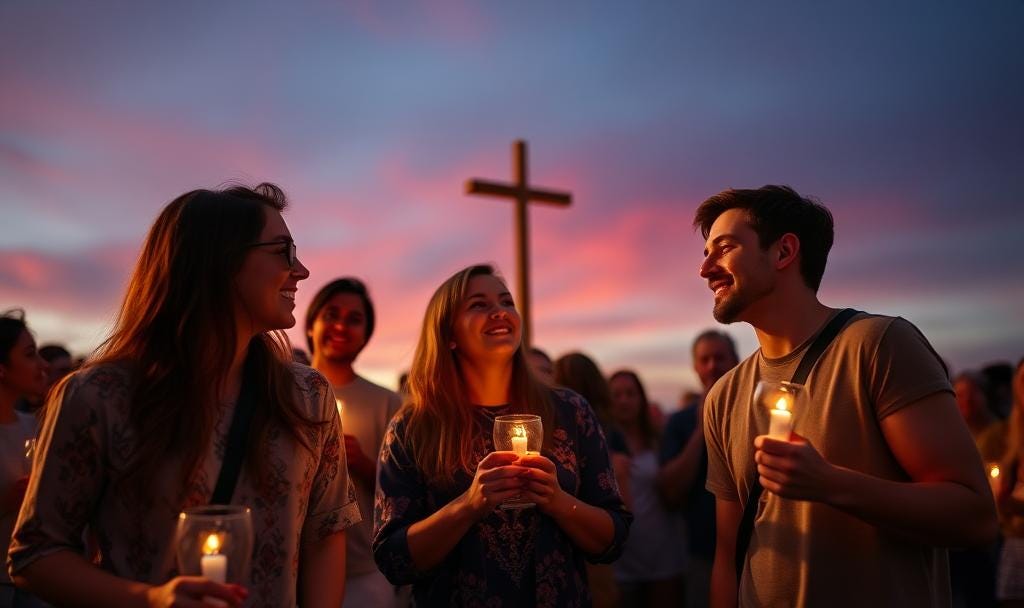
Christian millennials are quietly losing their faith without even noticing it.
We have replaced calling with ambition, joined influencer-owned communities instead of churches, and sought total freedom rather than a covenantal faith. Our social systems, such as economics, media, and politics, are often primed to steer us away from godliness. Over time, these shallow attractions pull us away from the very Source we need most.
Biblical history indicates that faithful movements began when ordinary young believers rebuilt old altars. If Christian millennials return to God now, the church will successfully pass the leadership baton to them in the next decade.
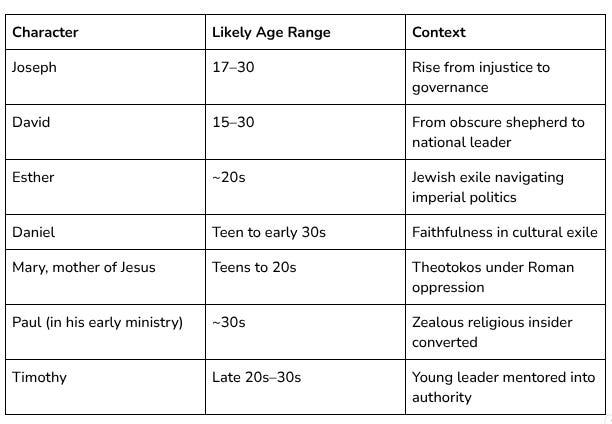
From Joseph to Timothy, God's chosen youths were negotiating systems and strongholds beyond their merits, including empires, corruption, religious bureaucracy, exile, and minority status.
God often empowers people through covenant faithfulness in their millennial years against oppressive systems. He calls young people because we are unburdened enough to pursue a vision and be resilient in adversities.
To all Christian millennials today, your age can be a strategy. You are called in the wake of recent attacks against a Christian worldview that has brought such great prosperity to the world. You can and should be God's agent of redemptive friction within them.
Now, you might say God uses everybody whenever he wants, so if not now, maybe later. One might even suggest that the age of youth isn't as significant as I am making it sound because Jesus knew he would die at about age 33, yet he began His ministry only three years prior. Yes, and you will be partly right, but even with him, God was working by an age pattern common among the Old Testament prophets.
Priests had internships1 and began their 20-year ministry, which typically lasted from around the age of 30 to 502. Jesus, our Great High Priest3, appears to have followed a similar pattern (Matthew 3:13-15).
The point isn't that you must be a millennial. It is that your thirties, especially for men, are significant enough for you to commit permanently to spiritual matters, including marriage and church leadership.
Twenty-something-year-old Christians are waiting until their thirties to become serious about godly matters, while the thirty-somethings are waiting for stability (after debt clears, when they earn team-lead promotions, or after making "real money").
Hear this:
God doesn't wait for stability. He calls people to it. He doesn't need you to figure things out. He could use your in-betweenness and the systemic frustrations that make us anxious? He has plans for them, too. So your youth is your ordination.
Therefore, the decision to be made is whether you will surrender to the systems around you or step boldly into your early vocation. Christian millennials appear to have surrendered. We have a shallow faith, are enticed by endless distractions, and live isolated lives. Little wonder we struggle to build good relationships and hold on to hope.
If millennials are to lead the church by the next decade and overcome the systems that drive young people away, we must stop waiting and start restoring what we've lost by rebuilding faith, community, and lasting purpose.
What’s up with Christian millennials?
As if the proliferation of social media weren't enough, the development and use of AI make resistance to content creation and personal aggrandizement (cum personal branding) seem unreasonable.
You're applying for a job? HR professionals expect you to include a LinkedIn profile. You must keep it updated with regular posts about things you've achieved, lessons you learned at work, and industry leaders you admire, whether true or false.
Christian millennials have caught up with the trends. We are constantly pressured to create and compete on various social media platforms, and stats (whether engagement or impressions) have become measures of likeability and resonance.
Social media innovators promised to bridge the gap between people; however, the ability of Christian millennials to communicate effectively has plummeted due to overreliance on technology, as reported by the Cultural Research Center at Arizona Christian University. It doesn't matter who you are or what you have to say; fame wins over conviction. Unsurprisingly, relationships are fleeting, for we've lost patience with one another, which we attribute to reduced attention spans.
What's worse? Though only 6% have a "very negative" view of Jesus as the Son of God, Christian millennials have redefined "Christian" to mean being a good person, regardless of embracing biblical beliefs or principles far off from the earliest "follower of Christ" meaning and its spiritual and covenantal imperative. In fact, fewer and fewer Christian millennials believe the biblical view of God as the all-powerful creator and universal ruler, as 74% think that all religious faiths have equal value.
About half of millennials who identify as Christians have a stronger sense of social justice than a commitment to the Gospel. We think it is wrong to evangelize to people of other faiths.
These observations don't indicate we want total disconnection from the church. Some don't know or even care to believe that God exists. The problem is that Christian millennials wish to redefine the faith for diverse reasons, including the unfortunate fact that far too many church leaders have ensnared themselves in sins that make even pagans choke.
We are washing away all perceived stains from the church by tearing down the uniqueness, supremacy, and exclusivity of the Gospel in whatever way possible.
However, our newer notions of the faith among Christian millennials are costly to all stakeholders.
The Cultural Research Center found that only 2% of American adults believe Hell is a place of eternal torment and do not acknowledge their sinfulness to God. How, then, would we embrace Jesus Christ as our Savior? We want to control our destinies now and after we die. So the death, burial, and resurrection of Jesus have diminishing significance. It's like saying, "Jesus, we understand you were crucified unjustly, but you didn't have to go through that for our sakes."
It would seem that since we have such a heightened view of ourselves and can redefine a spiritual movement that has outlasted generations of powerful nations, then all is well. Maybe not.
George Barna points out that Christian millennials struggle to discover purpose amid muddled worldviews. This spiritual poverty leads to a superficial outlook, favoring short-term comfort over the lasting truths and peace that the Gospel offers. Despite living in the most prosperous era in human history with more opportunities than our parents' generation, many of us still feel a lack of purpose. Things have gone awry because we refuse to be called according to God's purpose.
A Harvard researcher in 2023 stated that "far too many young adults told us that they feel on edge, lonely, directionless, and that they worry about financial security. Many are 'achieving to achieve' and find little meaning in either school or work."
We can't keep healthy relationships because we don't trust the people in our lives to do us good and are unwilling to make compromise. We'd rather tweet or send status updates than converse in person. We take nearly everything personally and believe morality is a simply a matter of preferrences. We are losing the family unit daily due to fewer formal marriages, increased levels of divorce, separation, liberalized sexual morality, and unhappiness about raising children.
Based on extensive research of Christian millennials, Barna says that rejecting God's presence and authority intensifies our feelings of anxiety and fear. We hold a low value on human life and disrespect others for daring to disagree with us, as the destruction of Elon Musk's property shows. Yet we think the world has become chaotic, as if we had no part in it.
Our misguided spiritual beliefs harm our health and overall well-being, and the systems that perpetually influence our lives appear to incentivize our destruction. The grand winner in all this isn't God. It's the devil. He gains if we are socially destructive and spiritually disengaged.
But the good news is that this isn’t the end.
We need a worldview that gives purpose.
The church can be glad that 14% of millennials want a better relationship with God, and 35% have already adopted a belief in Jehovah as the all-powerful, all-knowing creator of the world.
The church can build on these numbers in the next decade by championing a revival to raise millennials who are righteous and confident in God's ways. Why millennials? In the next decade, many of us will be old enough to be appointed elders and deacons in the church, and our parents will mostly have retired. Leadership succession will fail if we don't take this seriously. On our part, we must seek early vocation, renew our membership in Bible-believing churches, and confidently proclaim our faith.
Helping millennials adopt a Christian worldview is the most effective way to tackle the challenges facing them and restore their participation in the Kingdom.
Biblical data shows that we are made for connection, and our youth is the prime time to deepen our relationship with God and His church.
From the beginning, faith was never a private matter. Community was never optional, and purpose was never delayed. A biblical worldview will strengthen our faith, community, and purpose. Millennials need purpose. Seventy-five percent said they were actively trying to discover their purpose in life. The Centers for Disease Control (CDC) reported that suicide rates increased by 5% among men aged 25 to 34 in 2020.
A biblical perspective of life will help people build a relationship with Jesus Christ. He wants to transform us into new creations. 2 Corinthians 3:18 (NLT) states, "And the Lord—who is the Spirit—makes us more and more like him as we are changed into his glorious image."
We can return to prayer, rejoin the church, and recommit to divine calling. And it may not matter that we feel disconnected from God. We don't need to be ideally in tune with Him before He calls us, but a genuine movement towards Him is a huge step. The church needs dedicated young people to take action now, for God uses those who commit during challenging times.
Adopting a Christian worldview is essential for millennials today because it affords us a role to play in God's Kingdom and teaches us to play it young. God has a pattern of using young people who initially had little idea of the significant impact they would have in God's Kingdom. It worked in Babylon, Egypt, and Rome, and it still works today.
Numbers 8:24
Numbers 4:3
Hebrews 4:14